Parental Guidance
Background TV and Toy Play Behavior
The Effects of Background Television on the Toy Play Behavior of Very Young Children" examines how background adult television influences the play behavior of children aged 12, 24, and 36 months.
Society for Research in Children Development · 2008-07-14
Summary
Early childhood play is essential for cognitive and social development. Understanding factors that disrupt play can inform parenting practices and environmental settings to promote healthy development.
Key Findings
Disruption of Play Behavior:
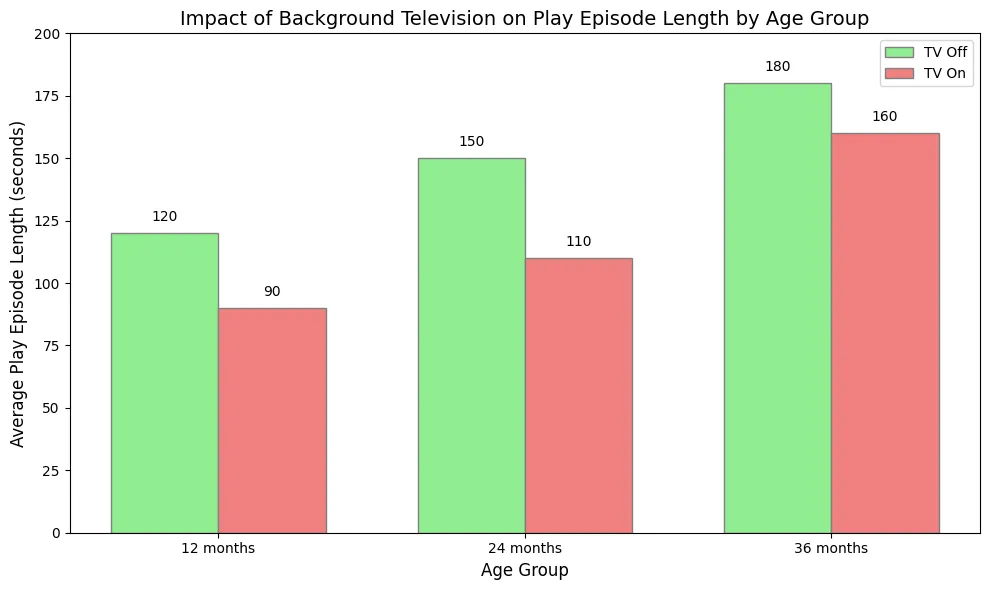
Background television significantly reduced the duration of play episodes and the level of focused attention during play, even though children glanced at the TV infrequently and for brief periods.
Age-Related Differences:
While all age groups experienced disruptions, younger children (12 and 24 months) showed more pronounced reductions in play episode length compared to 36-month-olds.
Implications for Cognitive Development:
The presence of background television may interfere with the development of sustained attention and play skills, which are critical for cognitive growth.
X-Axis:
Age groups: '12 months', '24 months', '36 months'.
Y-Axis:
Average play episode length in seconds.
Bars:
Two sets of bars representing play episode length with TV off and TV on for each age group.
Participants:
Fifty children divided into three age groups: 12 months, 24 months, and 36 months.
Methodology:
Each child participated in a 1-hour play session with a variety of toys.
For half of the session, an adult game show played in the background; for the other half, the TV was off.
Researchers measured the length of play episodes and the degree of focused attention during play in both conditions.
Implications:
The findings suggest that background television can disrupt play behavior in very young children, potentially hindering aspects of cognitive development. Parents and caregivers should consider minimizing background TV exposure during children's playtime to support sustained attention and engagement in play activities.

Built on the same research you're reading.
KidSafeTV — No addictive algorithms, no brainrot. Just approved content that ends calmly.