Cognitive Development
Screen-time inattention problems preschoolers
Screen-time is associated with inattention problems in preschoolers: Results from the CHILD birth cohort study" examines the relationship between screen time and behavioral issues, particularly inattention, in preschool-aged children.
PLoS ONE · 2019-04-17
Summary
With the increasing prevalence of digital devices, young children are spending more time in front of screens. Understanding the impact of screen time on early childhood development, especially concerning attention-related behaviors, is crucial for establishing appropriate guidelines and interventions.
Key Findings
Prevalence of Screen Time:
At 3 years of age, children averaged 1.5 hours of screen time per day.
By 5 years of age, the average was 1.4 hours per day.
Association with Inattention:
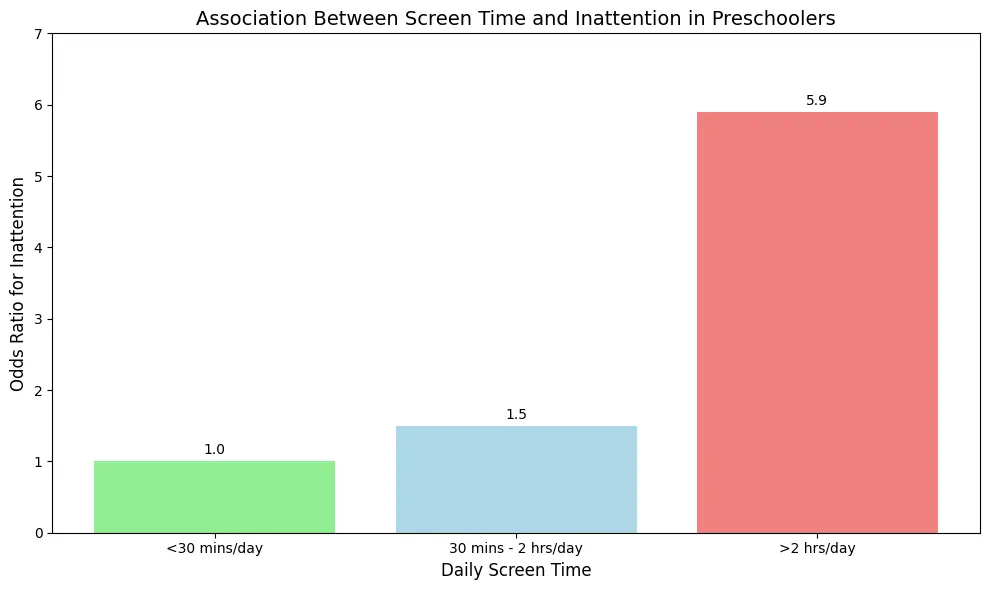
Children exposed to more than 2 hours of screen time per day were over five times more likely to exhibit clinically significant externalizing behavior problems, including inattention.
These children were also nearly six times more likely to meet criteria for attention-deficit/hyperactivity disorder (ADHD).
Protective Factors:
Participation in organized sports was associated with a lower likelihood of behavioral problems, suggesting that structured physical activity may mitigate some negative effects of excessive screen time.
X-Axis:
Daily screen time categories: '<30 mins/day', '30 mins - 2 hrs/day', '>2 hrs/day'.
Y-Axis:
Odds ratio for inattention, with '<30 mins/day' as the reference category (odds ratio = 1).
Bars:
Different colors represent each screen time category.
Population:
2,322 children from the Canadian Healthy Infant Longitudinal Development (CHILD) study.
Methodology:
Parental reports of children's screen time at ages 3 and 5.
Behavioral assessments at age 5 using the Child Behavior Checklist (CBCL).
Implications:
The findings suggest that excessive screen time in preschoolers is associated with a higher risk of attention problems and behavioral issues. Limiting screen time and promoting participation in organized physical activities may be beneficial strategies for parents and caregivers to support healthy behavioral development in young children.

Built on the same research you're reading.
KidSafeTV — No addictive algorithms, no brainrot. Just approved content that ends calmly.